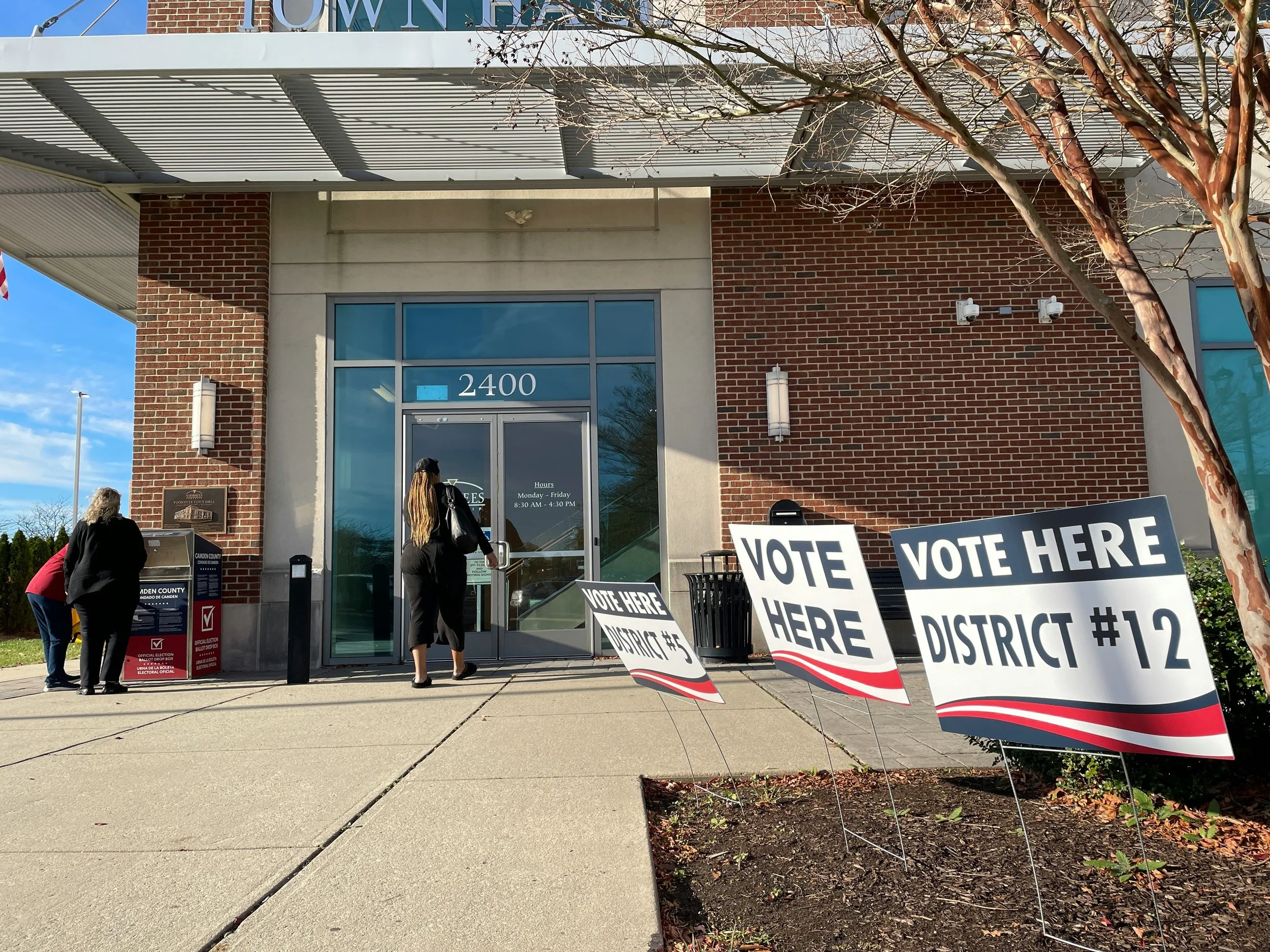
Gen Z, it's time to vote
By Amy Zhou | Editor in chief
Nearly 50 million young Americans will be eligible to vote in the 2026 midterm elections. Yet historically, younger Americans have been among the least likely age groups to cast a ballot.
The 2026 midterm elections will take place on Nov. 3, with voters across the country deciding all 435 seats in the U.S. House of Representatives and 35 of the 100 seats in the U.S. Senate. In Georgia, voters will also decide a wide range of statewide and local races, including those for governor, attorney general and other elected offices.
For Generation Z, those born between 1997 and 2012, elections are an opportunity to participate in decisions that will affect the rest of our lives.
As one of those young voters, I am determined to have a say in the decisions that will shape my life and career.
Voter turnout in the United States lags behind that of many other countries. In recent decades, only 60% of the voting-eligible population has participated in presidential elections, and turnout in midterm elections is around 40%.
Voter turnout for Gen Z in the United States is even more abysmal, at under 50%, lower than in most other countries with available data.
I am originally from Cleveland, Ohio, so I grew up more familiar with Ohio politics than with Georgia politics. My parents are both naturalized U.S. citizens, so exercising the right to vote was always important to my family and I.
Historically, Ohio was considered a key swing state. However, President Donald Trump carried the state in three consecutive presidential elections in 2016, 2020 and 2024, signaling its departure from being a presidential battleground.
A defining moment when I realized the impact younger voters can have on politics and our everyday lives came in November 2023, when Ohio Issue 1 appeared on the ballot.
Ohio Issue 1, or the Right to Make Reproductive Decisions Including Abortion Initiative, came in the wake of the U.S. Supreme Court’s decision to overturn Roe v. Wade, which ended the federal constitutional right to abortion that had been recognized since 1973. As a woman who hopes to pursue a career in healthcare, this decision scared me.
Because Ohio had shifted increasingly toward the Republican party by that point, I was not optimistic that the reproductive rights amendment would pass.
And yet, voters showed up. Women and young voters were among the groups that most strongly supported Issue 1. Young voters were particularly supportive, with more than three-quarters of Ohio voters under 30 voting in favor of the abortion rights amendment.
For me, these results exemplified the influence younger voters have when they participate in elections.
Now that I live and attend university in Georgia, I have made an effort to educate myself about the state’s politics.
In 2020, Georgia became a key swing state, voting statewide for a Democratic presidential candidate for the first time since 1992. In competitive states like Georgia, elections are decided by narrow margins, making voter participation especially consequential.
Gen Z is a large voting bloc in Georgia, and Atlanta is one of the top cities for young adults. Given the growing presence of this generation, young voters can exert significant influence in elections.
To better understand the importance of voting and the political landscape in Georgia, I spoke with Dr. William Hatcher, department chair and professor in the Department of Social Sciences at Augusta University.
If people want a say over the decisions made by our political system, they need to exercise that most basic right,” Hatcher said. “At times, it is difficult to see the effect our voting may have on politics, but that is even more reason for everyone of all age groups to be politically active.”
During both the last midterm and presidential elections, I was under 18, so I felt particularly powerless because I could not participate in one of the most basic forms of political participation: voting.
I remember asking many of my older friends whether they planned to vote, and several said no. They felt increasingly disillusioned with our government and believed that their individual votes would not matter.
Their words made me consider how many other young people felt the same way.
This past summer, I attended an event hosted by a friend featuring local feminist political organizer and leader Lana Moresky. I learned a lot about women’s history in my hometown and how the work activists began in their youth created tangible change in our city and across the country. She emphasized how optimistic she felt seeing so many young people in the room and reminded us that meaningful change often begins with younger generations.
Her message resonated with me. What could change if more young people simply showed up to vote and became more politically active in their communities?
Our upcoming midterm election will determine the political makeup of Congress. Historically, the president’s party has often lost congressional seats during midterm elections. Republicans currently hold majorities in both the U.S. House of Representatives and the Senate. As someone who would like to see a change in party control of Congress, the outcome of the upcoming midterm elections matters to me personally.
Although more people tend to just vote in presidential elections, I believe midterm, state and local elections have some of the most visible effects on our day-to-day lives.
Dr. Hatcher also agreed on the importance of voting beyond presidential and congressional elections.
“Most of the governing in our political system occurs at the state and local level,” he said. “For college students, many of the policies of public universities and also tuition decisions are made at the state government level.”
His comments made me think about the local issues I have encountered since moving to Augusta.
One issue I have learned more about recently is the expansion of data centers. Across the country, their rapid growth has raised concerns about energy use, water consumption and their environmental effects on surrounding communities.
These concerns have become relevant to me as Augusta is experiencing significant data center development, including QTS’s planned data center campus.
On Sept. 15, Augusta commissioners approved an ordinance restricting where future data centers can be built and establishing requirements for noise, buffers and water use.
The ordinance came in response to public pressure for stronger safeguards, with residents participating in district hearings and urging local leaders to tighten regulations.
Augusta is home to undergraduate, medical, dental, nursing and Ph.D. students. With so many young people living and studying here, local political issues such as data center development are topics we should learn about and engage with through the government.
This is why I believe that increasing civic education is essential to getting more young people involved in local politics and becoming lifelong voters.
“Knowing how the political system works is important to help inform voters and give them a realistic view of what government can and cannot do,” Hatcher said when asked about the importance of civic education. “Being more informed about government and politics tends to increase political participation.”
This week, I asked several of my friends here whether they planned to vote. Many of them said no because they were not even registered to vote.
“Often younger voters aren’t registered to vote. Registration can be a barrier in our political system because it is a bureaucratic process that takes time,” Hatcher said.
I asked Dr. Hatcher what other barriers to voting are among college students in Georgia.
“College students often struggle to know where they’re registered,” Hatcher said.
I experienced both of these barriers myself. After moving permanently from Ohio to Georgia, I had to establish Georgia residency. Changing my driver’s license, filling out new tax forms and handling other residency requirements became an exhausting process.
By the time I finally became a Georgia resident, I felt too overwhelmed to put additional time into learning about Georgia politics and registering to vote. My experience helped me understand how the process of registering and staying politically informed can discourage young people from participating, even when they care about politics.
But after putting in the effort, I am glad I did because I realized that participating in politics allows me to influence the decisions that can shape my life and my future. Becoming politically active does not happen automatically. It requires us to initiate the first step.
To those who want to vote in the upcoming midterm elections but feel overwhelmed or confused, start by educating yourself. Read the news about the election and contentious topics. Visit candidates’ websites and learn about their backgrounds and positions. Learn how our political system works. Remember that the right to vote is one that many have fought and died for us to have.
Most importantly, find a way to actively participate. That can mean voting, volunteering for a campaign, attending local government meetings or communicating with elected officials.
I used to wonder whether one person’s participation could really make a difference. My experiences in Ohio and Georgia have taught me that real change requires people to first show up. Gen Z represents millions of new voters, but that number only matters if we choose to participate.
For me, that starts with casting my vote this November.
For more information regarding Georgia’s upcoming elections: https://georgia.gov/georgia-election-guide
Note: Image at the top of the page by Ernie Journeys on Unsplash.
Contact Amy Zhou at amyzhou@augusta.edu