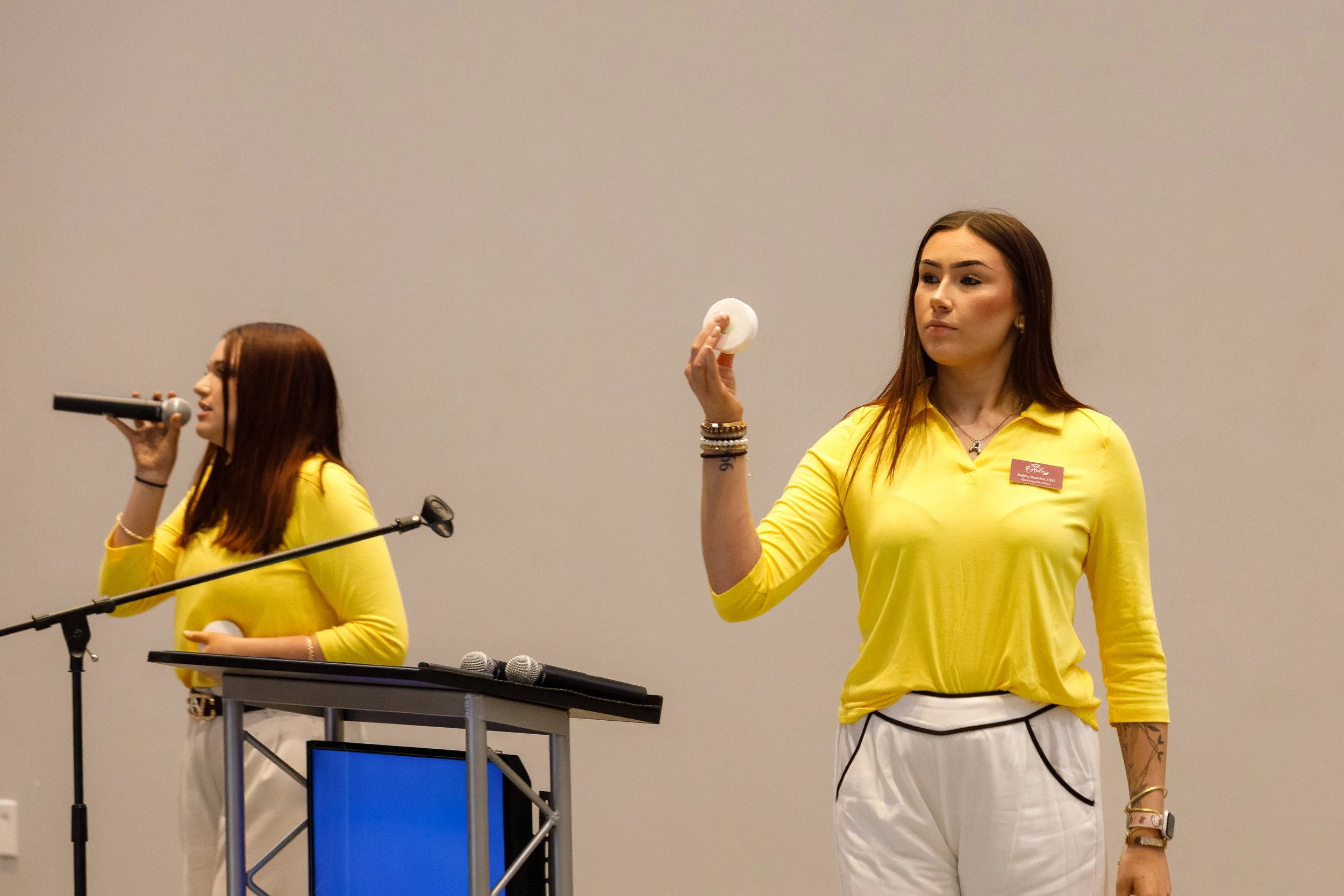
Making soap, giving hope
By Amy Zhou | Staff writer
Augusta University students competed in the Innovate Pitch Competition at the Georgia Cyber Center on March 22.
The event, run by AU Academic Entrepreneurship, featured 25 teams from undergraduate, graduate and community entrepreneur categories, each presenting innovative solutions to community challenges. Finalists had five minutes to pitch for a $5,000 award after advancing from a March 10 preliminary round.
Senior Emily Nicholson and junior Raiyna Bearden, both business majors, won first place in the undergraduate category with HALO with Wings, a project providing affordable hygiene products to underserved communities.
They were advised by Hull College of Business lecturer Roger Duke, who encouraged them to compete in the Innovate Pitch Competition and guided them from idea to product.
Nicholson and Bearden met in Duke’s class last semester, when students completed a project focused on identifying a group with a specific need and developing a solution to address it.
The project originally began as a way to help college students but quickly expanded to address a broader need.
“There is a large number of people who can’t afford hygiene products in the CSRA (Central Savannah River Area),” said Nicholson, who is concentrating in professional sales and served as the chief marketing officer for the project.
“If you had to choose between food or soap for the week,” asked Bearden, a business major with concentration in healthcare management and the chief executive officer for the project, “what would you choose?”
After extensive research, the team found that low-income families struggle to afford hygiene products, which are not covered by federal programs like Electronic Benefits Transfer (EBT) and the Supplemental Nutrition Assistance Program (SNAP). In fact, 34 percent of people who cannot afford hygiene products actually decide to skip them.
On average, people spend about $30 a month on hygiene products, totaling $360 annually, a cost difficult to manage for many low-income families compared to necessities like food or rent.
“Soap, shampoo, detergent and other hygiene products are basic necessities that impact overall health,” Nicholson said. “We decided that instead of buying soap for people, it would be more beneficial to make it ourselves, and that ultimately turned our class project into a business model.”
Nicholson and Bearden brainstormed ways to push their idea beyond simple soap making. Duke encouraged them to begin by identifying common issues associated with commercial soaps.
“Homemade soap is expensive,” Duke explained. “It comes in a bar shape which is difficult to cut or hold onto when you’re in the shower.”
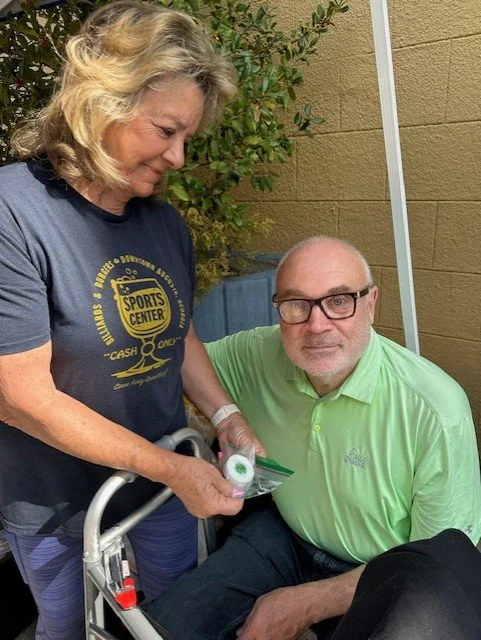
At left, Tracy Showman, Project Refresh chair, providing a HALO bar to a shower day guest. HALO donated over 50 bars to Project Refresh. (photo by Amy Zhou/the Bell Ringer)
That is how the team landed on the unique design of HALO. The handmade soap is shaped like a circular ring, resembling a halo.
Duke spent significant time researching how to make cost-effective soaps. Ultimately, he came up with a recipe of three basic oils: Olive, coconut and castor.
“The soap is really simple with no additives or fragrances,” shared Duke. “It is an all-in-one bar that you could use for shaving, shampoo and bathing.”
The HALO bar costs less than 20 cents per ounce to produce. Many HALO soaps will be donated to charity, while those who can afford them can purchase a subscription for $1 a month.
“We believe that every person who purchases HALO with Wings is helping out the community,” Nicholson said. “We are recruiting our angels.”
Though simple, the formula is non-irritating unlike many commercial products and has already shown positive results.
“One girl in our class was able to use our soap without exacerbating her eczema,” Nicholson explained.
The team took their design a step further by introducing customization for different users. At the center of the HALO ring is a customizable insert, called “Wings,” designed to address specific needs such as eczema, acne or custom fragrances.
“This makes the product completely unique, and the fact that we are doing this for the community is why they won the competition,” said Duke.
The team is currently working on finalizing the formulas for each type of Wing, such as an aloe vera–based recipe aimed at relieving sunburn.
Reaching the competition, and now moving into refinement of recipes, manufacturing and distribution to the general population, has not been easy for the team.
Originality was the immediate challenge. According to a report at Harvard Business School, 30,000 new products are introduced each year, and 95 percent of them fail.
“There's a concept called the Blue Ocean Strategy where you don't try to beat your competition. You try to create a niche,” Duke explained. “Coming up with that niche was a big challenge.”
Designing the mold and determining the exact dimensions of the HALO and Wing to fit together was also challenging.
“My degree's in engineering, so I love creating, designing, and fabrication,” said Duke. “It’s exciting that we can make a bar that’s totally different and hasn’t existed before.”
Serving the community is the heart of the business. The team plans to donate more than 100 handmade soaps to the Open Paws Pantry for Augusta University students, along with continued support for other non-profit organizations.
“I learned a lot about the community and their needs,” Bearden said. “A major learning lesson for me was that I am blessed to have hygiene products in my household.”
Nicholson agreed, “People ran through our donated products at Hope House so quickly. That opened my eyes because hygiene was not something I thought people struggled with.”
For students interested in participating in the Innovate Pitch Competition or starting their own business, the team encourages them to take the leap.
“Public speaking really scares me,” Bearden admitted, “but this experience taught me that I am capable of doing those hard things.”
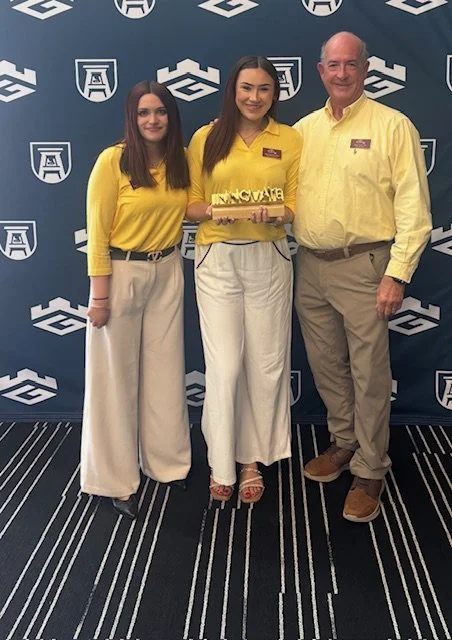
Business students Emily Nicholson (L) and Raiyna Bearden, along with mentor Roger Duke, with first-place trophy for winning the AU Innovate 2026 competition. (photo by Amy Zhou/the Bell Ringer)
“Don’t be afraid to ask for help or guidance,” Nicholson added. “So many ideas never become reality because people are afraid to fail. But if you’re willing to ask for help and learn from your mistakes, there’s no reason you can’t succeed and grow.”
The team has high hopes for the future of their business.
“We found a warehouse to distribute our products thanks to Augusta Training Shop,” Nicholson shared. “During the summer, we're setting up that operation.”
The next phase includes expanding the product to more nonprofits and students, continuing the team’s mission to support the community. Once a strong foundation is established, the team plans to expand to the broader market.
The team’s success with HALO with Wings was not just a win for themselves, but a win for the community as well.
Note: At the top of the page, Augusta University undergraduates Emily Nicholson (L) and Raiyna Bearden won first place in the undergraduate division at INNOVATE 2026. (photo by Emannuel Faminu/Augusta University)
Contact Amy Zhou at amyzhou@augusta.edu.