The whistle has become the story: Why officiating is failing sports at every level
By Rodrigo Burgos Avila | Sports editor
For years, one of the most common phrases in sports has been, “Don’t let the referees decide the game.”
The problem is that lately, they keep becoming the story.
Whether it is in the NBA, NFL, MLB, WNBA or even college athletics, officiating has become one of the most discussed subjects in sports. Fans are frustrated, players are openly criticizing officials, coaches are risking fines to speak out, and leagues are increasingly turning toward technology in search for answers. What once felt like isolated mistakes now feels like a larger problem spreading throughout sports.
The question is no longer whether officiating has an issue. The question is why.
The Scott Foster problem
One of the most controversial examples is NBA referee Scott Foster, who has spent decades working some of the league’s biggest games and has officiated numerous NBA Finals. Yet among fans, he has become arguably the most recognizable referee in professional sports alongside the likes of Tony Brothers and Mark Davis. That alone should raise concerns.
Referees are not supposed to be celebrities.
Foster’s reputation has earned him the nickname “The Extender,” a reference to the widespread belief among fans that playoff series tend to go on for longer when he is assigned to officiate games involving teams facing elimination. The nickname has become so common that social media immediately erupts whenever Foster is assigned to a major playoff mactchup.
There is no major evidence proving that Foster manipulates games or that the NBA intentionally uses him to extend playoff series. In fact, some independent statistical analyses have argued that “The Extender” narrative is exaggerated or unsupported by the actual numbers.
But that is almost beside the point.
The fact that millions of fans immediately distrust an official before a game even starts is damaging enough. Sports leagues depend on public confidence. Once fans begin expecting controversy whenever a certain referee appears, the credibility of the product itself suffers.
And Foster is not the only example.
The NBA has spent years battling criticism regarding consistency. One night a play is called a foul, the next night the exact same contact is ignored. Coaches constantly complain about shifting interpretations of physicality. Players frequently leave games unsure of how certain rules are being enforced.
The league understands the problem. The NBA continues investing heavily in referee development and recently promoted several officials from the G League pipeline, which serves as a training ground for future NBA referees.
That development pipeline is critical because the problem may begin long before officials reach the professional level.
Across college and amateur sports, there is a growing shortage of officials. Conferences and athletic organizations throughout the country have repeatedly reported declining numbers of referees entering the profession. Many younger officials are leaving because of the constant abuse from fans, parents, coaches and even players. Much of that abuse occurs on social media.
As a result, the pool of developing officials becomes smaller.
When fewer people went to officiate, leagues are forced to promote less experienced referees more quickly. The overall quality of officiating inevitably suffers. the issue is not simply that referees are making more mistakes; it may be that sports are struggling to properly develop the next generation of officials in the first place.
That theory becomes even more convincing when looking beyond basketball.
This isn’t just an NBA issue
Major League Baseball has spent years experimenting with Automated Ball-Strike systems because frustration with umpiring has reached a point where many believe technology could outperform humans. MLB tested challenge systems during spring training and continues moving toward some version of automated strike zone assistance.
Think about how remarkable that is.
Baseball is one of the most tradition-rich sports in the world. For generations, the strike zone was viewed as part art, part science. Yet now the league is seriously considering technology because trust in human consistency has weakened.
The same pattern appears elsewhere.
The NFL faced heavy criticism following multiple controversial calls during recent postseasons, prompting increased emphasis on referee accountability and evaluation.
The WNBA, currently experiencing unprecedented growth, has also see officiating become a major talking point. Players and coaches have publicly criticized inconsistency, while observers have pointed toward structural issues such as limited resources, smaller officiating staffs, and development challenges.
Different sports. Different rules.
Same conversation.
This is why blaming individual referees misses the bigger picture.
The real problem may be the pipeline
Sports fans often search for villains. Scott Foster becomes the villain in basketball. Angel Hernandez became the villain in baseball before his retirement. Certain NFL crews become weekly targets online. But focusing exclusively on individuals ignores the possibility that officiating systems themselves are struggling.
Professional sports have never moved faster.
NBA players are bigger, stronger and more athletic than ever. Baseball pitches are traveling at velocities that have not been seen before. Football offenses are more complex. Replay technology exposes very missed call from multiple angles in ultra-high definition.
Yet referees are still expected to make split-second decisions in real time.
The demands have increased dramatically. Development systems have not necessarily kept pace.
At the collegiate level, the situation may be even worse.
College sports often serve as the training ground for future professional officials. if there are fewer people entering officiating, fewer opportunities for development, and more burnout among young referees, professional leagues eventually inherit those problems. The NBA cannot simply create elite referees overnight. They must come through years of experience at lower levels.
If that pipeline weakens, the consequences eventually reach the highest stage.
Technology can help, but it isn’t the answer
Technology can help. Replay system can help. Automated systems can help in certain situations.
But technology alone cannot solve a development problem.
Sports still need talented officials. They still need people capable of managing games, communicating with players, controlling emotions, and applying rules under pressure. No computer can fully replace that human element that is so crucial to all the sports that we love.
The whistle doesn’t have to be the story
The long-term solution may require leagues to invest more heavily in recruitment, education, training, and retention. Officials need clearer development pathways. Young referees need support instead of constant harassment. College conferences and professional leagues need stronger partnerships to ensure the next generation is prepared.
Otherwise, the cycle will continue.
Fans will keep arguing about Scott Foster.
Baseball will keep debating robot umpires.
Football fans will keep questioning officiating crews.
And every controversial call will reinforce the growing belief that the people responsible for enforcing the rules are falling behind the games themselves.
Because maybe the real problem is not on referees.
Maybe the real problem is that sports have spent years developing better athletes, better coaches, and better technology while failing to develop officials at the same rate.
Until that changes, the whistle will keep becoming the story.
And that is the last thing any sports should want.
Contact Rodrigo Burgos Avila at rburgosavila@augusta.edu.
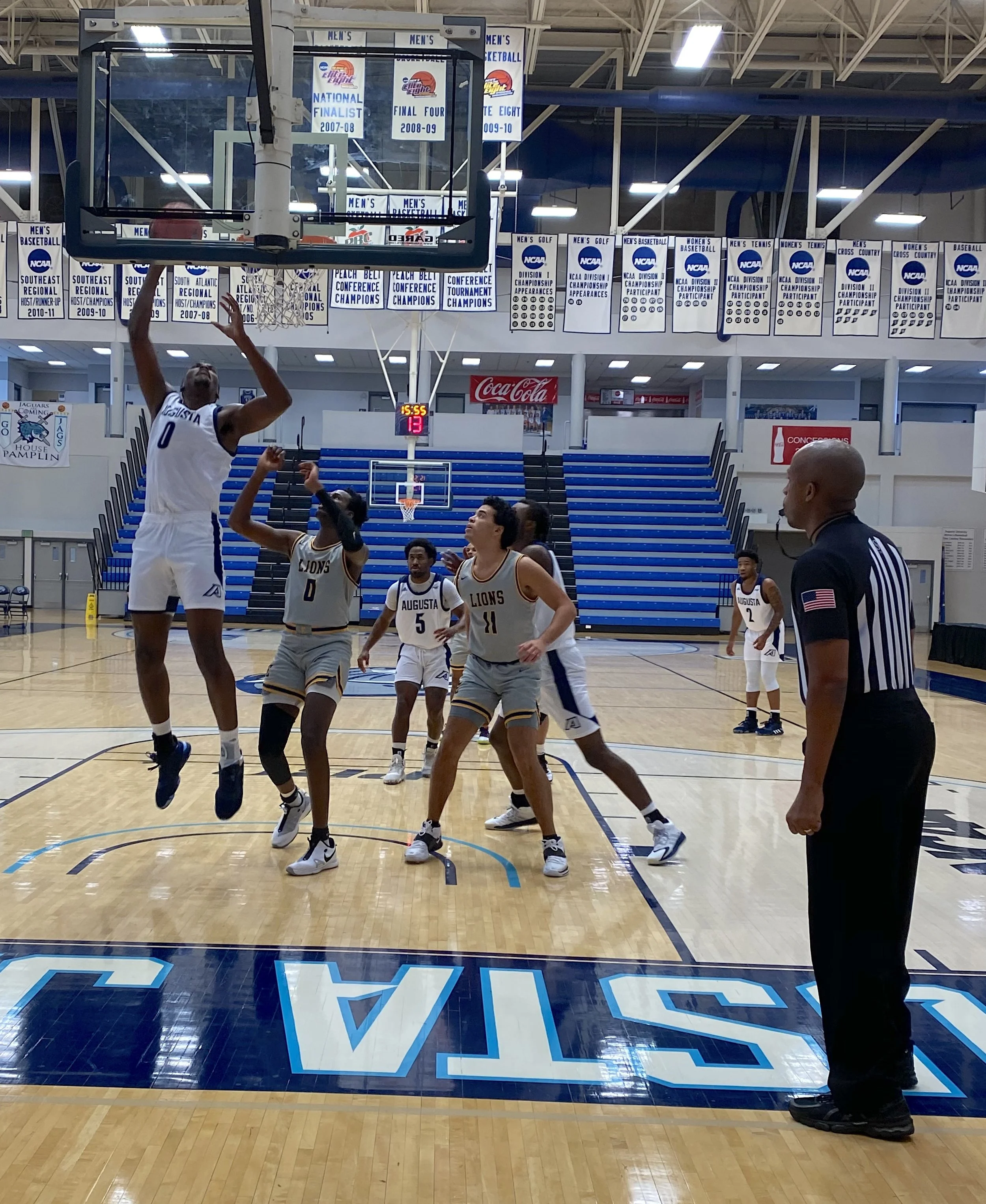
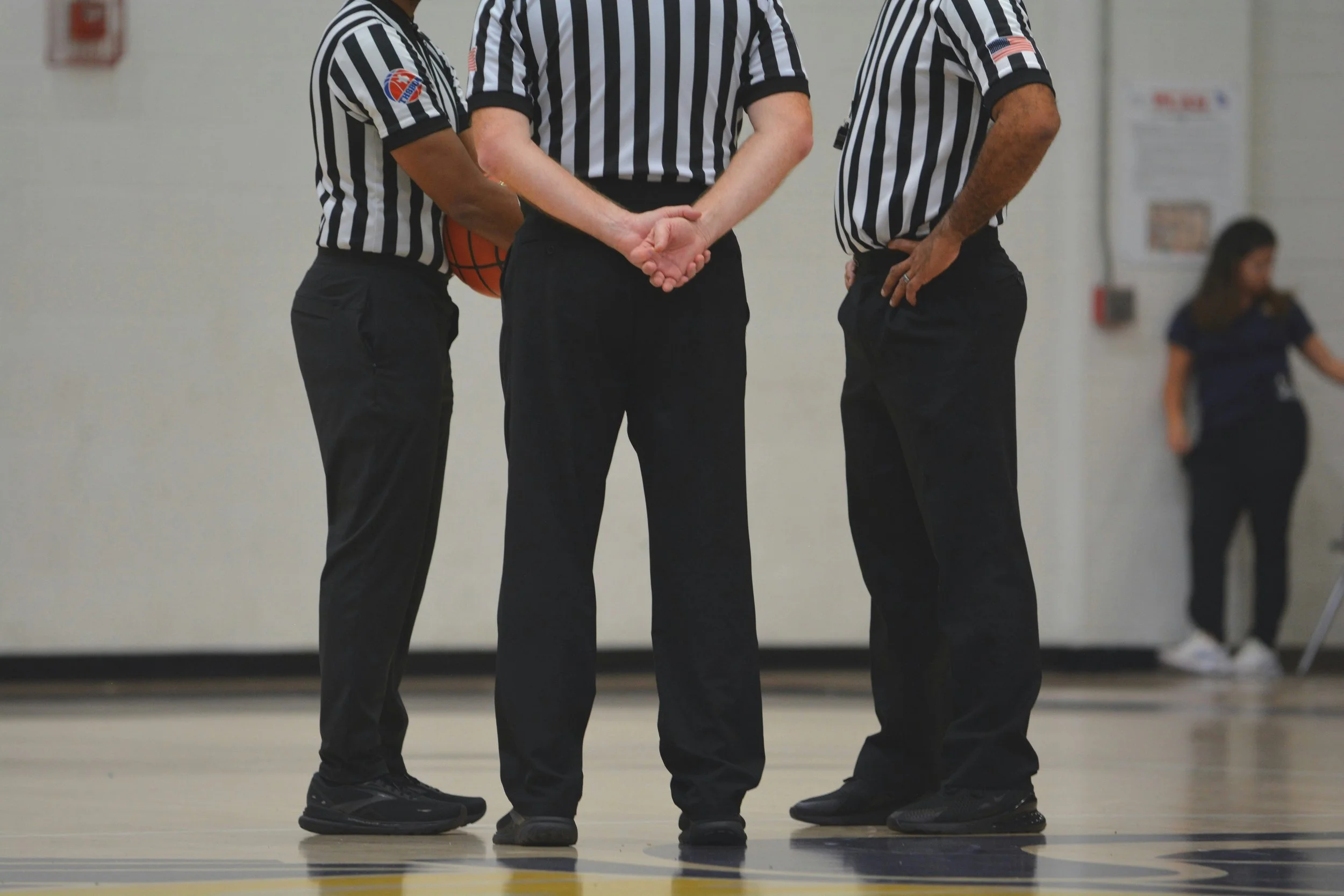
At right, a referee getting a close view of the action in an Augusta University men’s game from 2020. (Bell Ringer file photo) At the top of the page, referees meet during a timeout. (photo by Lesli Whitecotton for Unsplash)