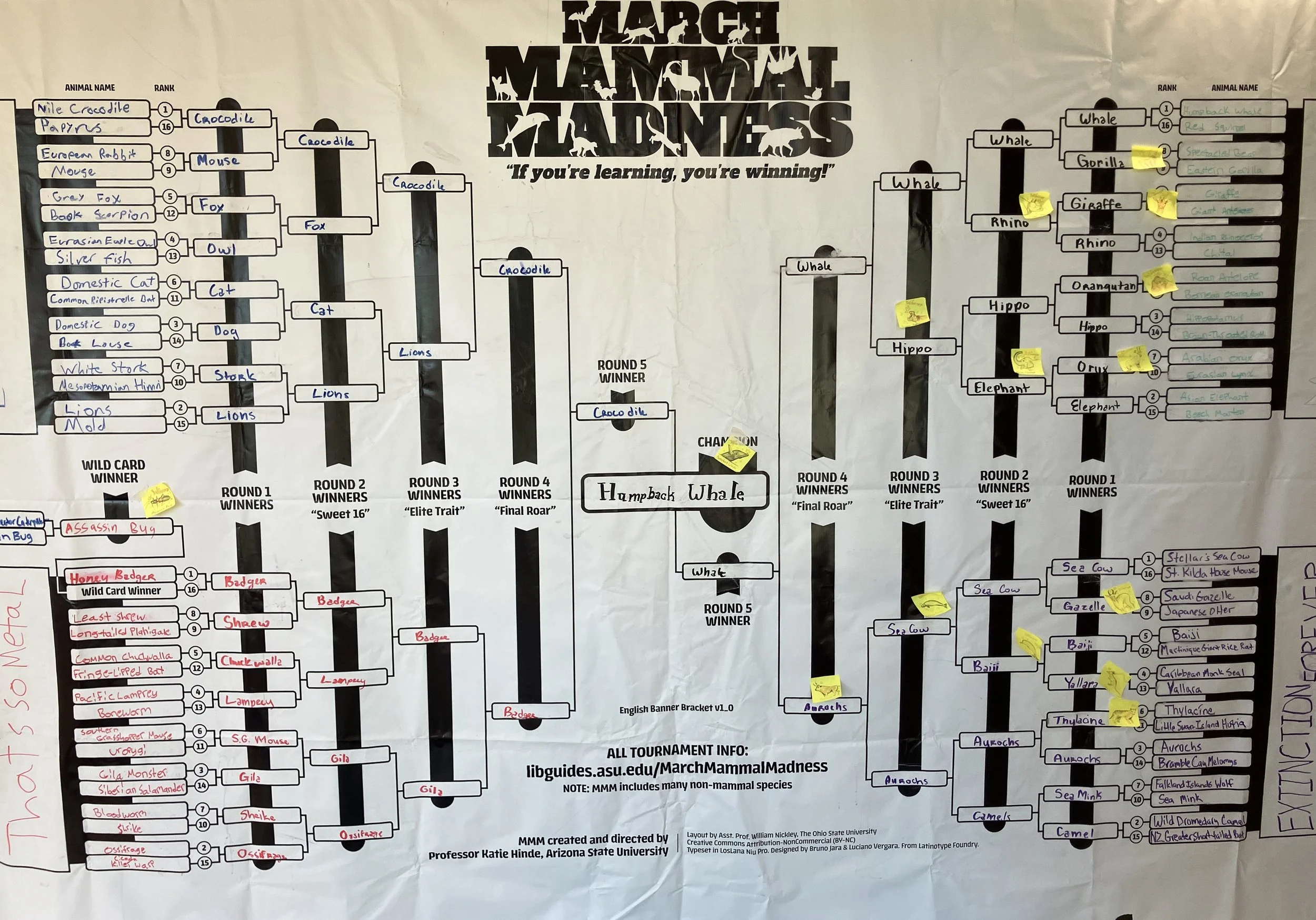
March Mammal Madness: From classroom experiment to national phenomenon
By Gabrielle Rodriguez | Contributor
Every March, as millions of Americans fill out brackets for the NCAA basketball tournament, another kind of competition unfolds in classrooms across the country.
Instead of college hoops teams, however, the competitors up for the championship consist of mainly animals from squirrels to whales, battling in carefully researched, hypothetical encounters. Known as March Mammal Madness, the event has grown over time from a small academic experiment to a nationwide educational movement that utilizes the familiar format to get students interested in learning about animals and their environment.
March Mammal Madness, originally Mammal March Madness, was created in 2013 by biologist Katie Hind, who at the time was a professor at Harvard University. Taking inspiration from the NCAA’s March Madness tournament and the excitement surrounding the competition, Hinde sought to replicate the energy in a scientific context. Hinde, who now teaches at Arizona State University, designed the project to be a similar bracket-style competition featuring 64 animal species, each seeded and organized into themed divisions that mimic that of the basketball tournament.
The idea, according to Hinde, was in part a response to less intense animal vs. animal competitions that were circulating on online forums that often lacked in scientific accuracy. Instead, March Mammal Madness would be grounded in real scientific research. To this day, each matchup is determined using data on points such as an animal’s size, habitat, diet, defense mechanisms, and evolutionary adaptations.
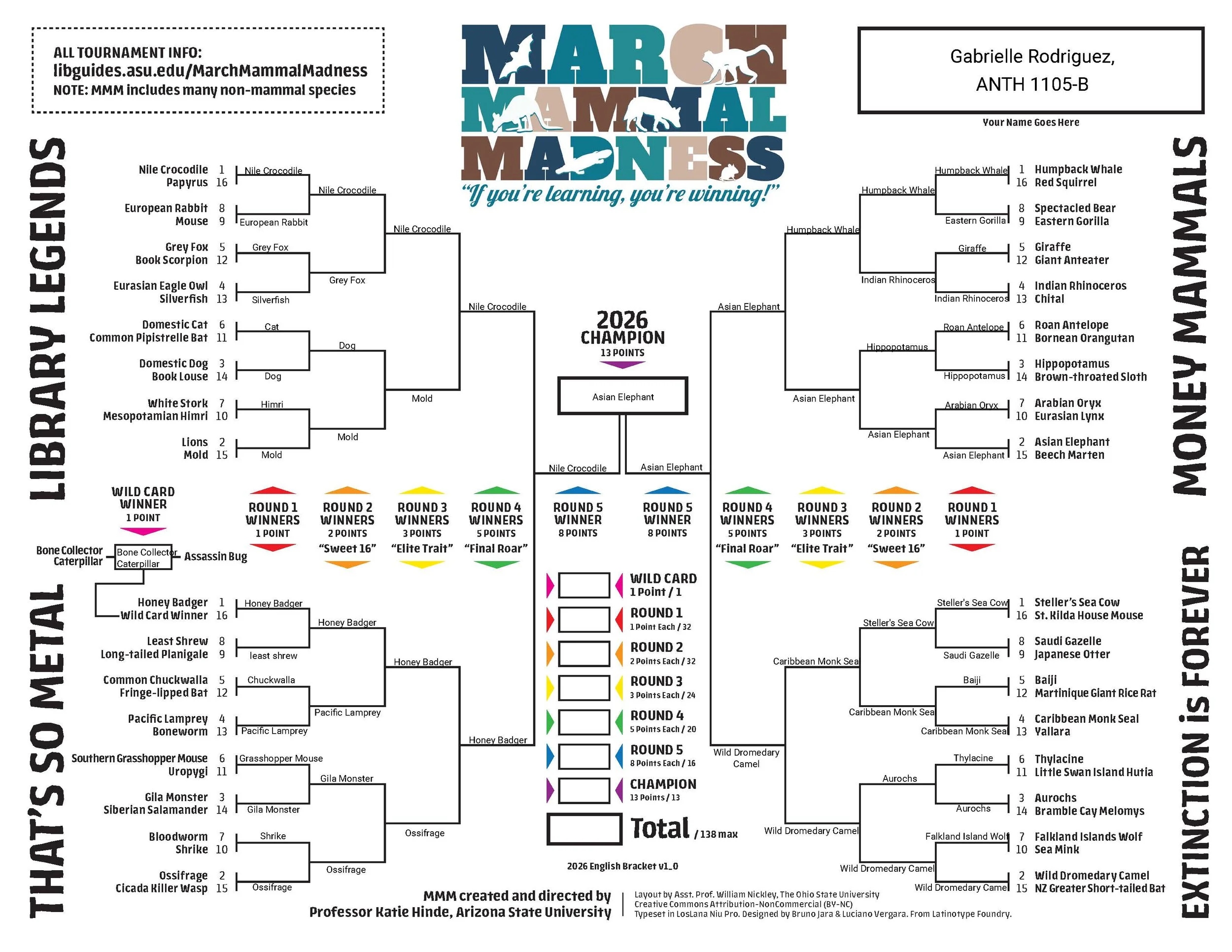
The brackets before March Mammal Madness 2026 started. (image by Gabrielle Rodriguez)
In an interview with Oxford University Press, Hinde explained the project’s creation.
“Back in 2013, I came across an ‘Animal Madness’ bracket online,” she said. “I was disappointed to find it only contained 16 animals and that the outcomes were based solely on their cuteness, rather than science. In response, I created Mammal March Madness, a 64-animal bracket with the goal of mixing fun narrated battles with scientific research of the many species involved.”
From the beginning, the project stood out in the community for its creative approach. Rather than simply posting the winners and results, Hinde and her collaborators would narrate each matchup as if it were a live, play-by-play recap, often shared on social media platforms. These narratives connected the scientific aspect with dramatic storytelling, turning academic research into an engaging experience that captured both students and educators alike.
What started out as a passion project for Hinde quickly gained traction not just locally, but online and then nationally as well. Hinde initially expected only a handful of participants from people that she knew, but the competition soon exploded, drawing widespread interest from scientists, educators and librarians across the country. Over the years, many joined the effort, expanding both the scale and the sophistication of the tournament.
MMM has huge following
Today, March Mammal Madness reaches hundreds of thousands of participants annually, with a particularly strong presence in schools stretching across the United States. According to data from an eLife article on the project, the event reached roughly 1 percent of all U.S. high school students by 2019, a significant figure for a scientific outreach initiative.
Its success in classrooms is no accident. Educators have widely adopted March Mammal Madness as a teaching tool, using the bracket format to encourage students to research species, as well as analyze ecological relationships while applying scientific reasoning. Before each round, students utilize the data they have collected to predict winners based on evidence, all while learning about key concepts such as adaptation and predator-prey dynamics along the way.
Professors of a variety of disciplines also embrace the flexibility of the project. While it is most commonly used in biology classrooms, March Mammal Madness has been incorporated into subjects ranging from other sciences such as anthropology, to seemingly unrelated topics, such as statistics. By gamifying science and turning it into a bracket-based contest, students in any class become emotionally invested in the outcomes, which in turn creates permanence in academic lessons that they take with them long after the tournament has ended.
Wakefield brings MMM to AU
Such is true even here at Augusta University, with 2026 being the first year that March Mammal Madness has taken place on Summerville campus grounds. Anthropology lecturer Elizabeth Wakefield, along with a few other anthropology and biology professors, started offering participation as an incentive for extra credit opportunities for students, but they hope it will inspire past surface level, eventually driving students to be more interested in scientific fields.
“I actually started doing March Mammal Madness when I taught high school in Miami,” said Wakefield, who teaches biological anthropologist. “I guess you could consider them kind of a pilot study on how to incorporate March Mammal Madness into a variety of different classrooms, because I was actually able to recruit students from several different classes to participate in that. They were just really excited to participate and learn about the mammals and why were we pitting them in these death matches against each other.”
For Wakefield, March Mammal Madness is a way to bring students together under a common interest through something that is already familiar to them. For Augusta University students, college basketball is already considered a widely popular topic. As the project follows a similar format with brackets and divisions that is seen in basketball, bridging the gap between a shared cultural experience and formal learning is remarkably effective.
Victoria Johnson, a psychology major at Augusta University, noted that participating in March Mammal Madness in her anthropology course this semester encouraged her to continue learning outside of the classroom, although she is not a science major.
“Participating in March Mammal Madness made me want to further search up a few of the animals just because I was so curious about all of them and learning the little habits and traits of each of them, so to me it was really interesting,” Johnson said.
Johnson’s experience reflects what Wakefield hopes March Mammal Madness can accomplish for students across disciplines. By using a bracket-style competition that feels both familiar and engaging, the project encourages students to explore scientific concepts on their own, often without realizing how much they are learning in the process.
“Some people don’t like to be told that they’re learning when they’re learning, so if we can try to trick them into doing that by playing a game, I think that that is helpful for them because they don’t even really know that they’re actually learning and expanding their mind on the things that we’re asking them to research,” Wakefield stated.
Beyond its popularity, March Mammal Madness holds deeper significance as a model for science communication by helping bridge the gap between the public and science. At its core, the project demonstrates how more complex research can be made attainable and even fun without sacrificing accuracy. By combining scientific elements with popular subculture, the tournament helps break down barriers between science and the younger generation.
Having fun learning
Robert Cromer, associate professor of biological sciences, wanted to get his class involved with March Mammal Madness when he heard about the tournament from Wakefield as he found it to be a fun, hands-on approach to teaching his students about animal species.
“It seemed like a fun way to get the students involved,” Cromer said. “I remember we were doing stuff in one of the labs, and we made it into like a March Mammal Madness competition and they had fun, so just to get them to get excited about animals and get them following it and having a good time with it is the reason.”
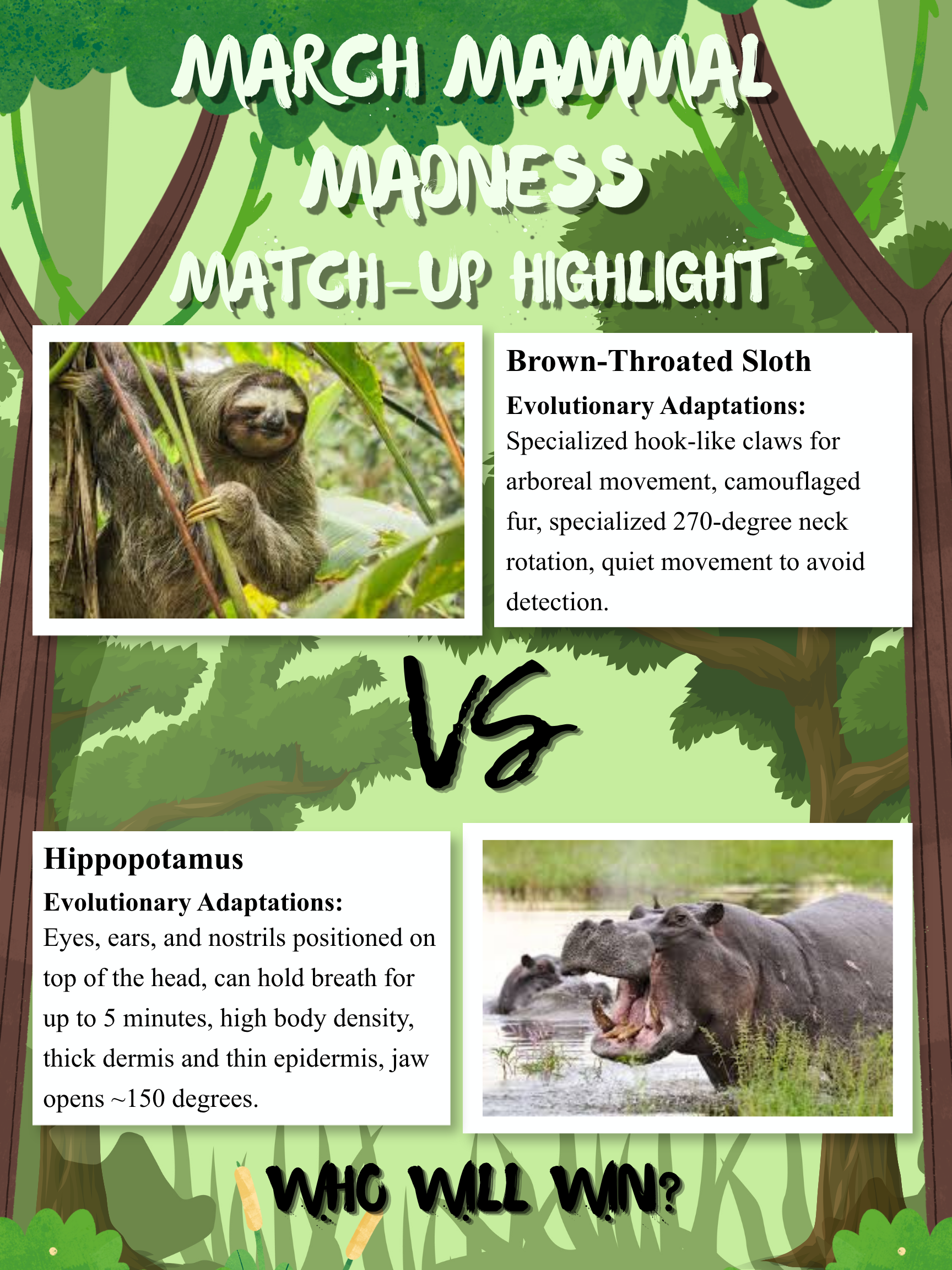
A typical matchup: Brown-Throated Sloth v. the Hippopotamus. Who wins?
This unique approach addresses the longstanding challenge in science education of making abstract or technical material relatable to the everyday individual. Many scientific studies remain inaccessible to the general public due to specialized language and limited exposure. March Mammal Madness makes an effort to counter this by translating scholarly research into an understandable context that captures people’s attention and sparks curiosity.
The tournament also highlights the importance of interdisciplinary collaboration. Scientists, educators, librarians and even students work together to produce each year’s event, blending expertise from multiple different fields. This collaborative model is not only beneficial to the competition but reflects the interconnected nature of modern science.
More than a decade after its creation, March Mammal Madness continues to grow, evolving each year with new technology and new species. Although the outcomes of the battles may be unusual, the tournament has a clear impact on transforming the way science is taught and experienced.
As society evolves, involving and interesting students in STEM fields remains a steadfast priority, and the March Mammal Madness tournament offers a compelling example of how to bring new fascination to old topics. By turning science into a competition, the scientific outreach project has captured the imagination of the upcoming generations and redefined what learning can look like.
Contact Gabrielle Rodriguez at GARODRIGUEZ@augusta.edu.
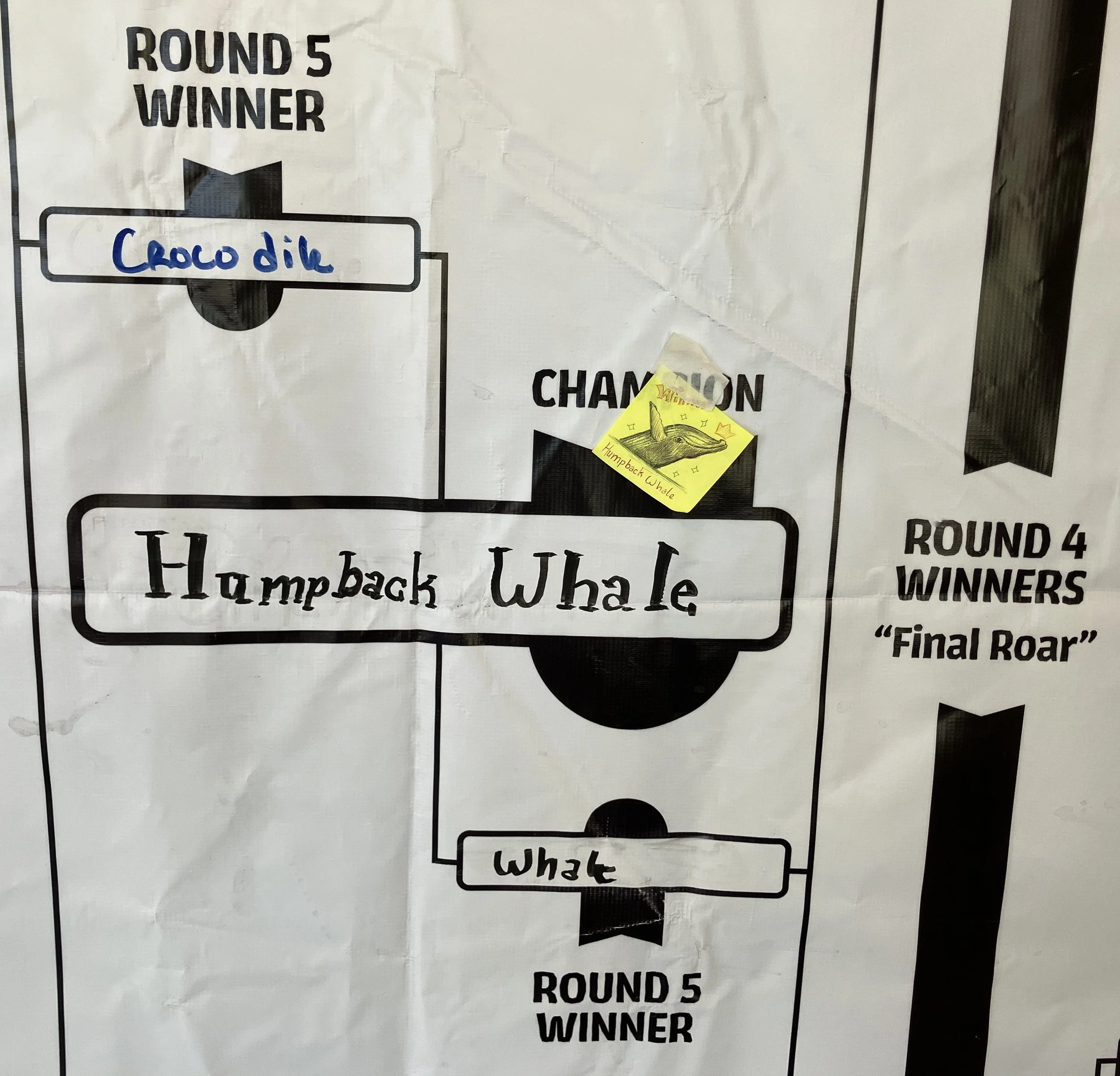
And the champion for 2026 is? The Humpback Whale over the Crocodile, as seen on the huge brackets in the Science Hall atrium on the Summerville Campus of Augusta University. (Bell Ringer file photo)