Primary election nears with challengers for Ossoff, Allen seats and governor's office on ballot
By Steve Schwartz | News editor
Now that the early voting in Georgia concluded on Friday, May 15, it is time to turn our attention to the primary election on Tuesday, May 19.
Primary elections represent one aspect of communication between voters and their party. Democrats, Republicans or the occasional, yet improbable, third parties. Georgia’s primary is an open primary. The “open” primary is the most common and flexible primary election method—where the registered voter chooses to participate in their preferred party’s primary. This informs the political party of its constituents’ preferences.
After arriving at an appointed polling place, verification and approaching the ballot-marking device, select a ballot, and vote. Georgia uses electronic machines where voters input their vote and generate a filled ballot. Then, the ballot is scanned into another machine. Then, to complete the process, voters are offered a sticker and directed to the door.
Considering the manner of election: each state receives authority for conducting elections as stated in Article 1, Section 4, of the U.S. Constitution: “The Times, Place, and Manner of holding Elections for Senators and Representatives, shall be prescribed in each State by the Legislature thereof.”
For Georgia’s May 19 primary, there are three official ballots: Democratic, Republican and non-partisan. The official nonpartisan ballot provides access to a set of nonpartisan general election competitions, including three of the nine Supreme Court of Georgia Justice seats and seven Georgia Court of Appeals Judges’ positions. Democratic and Republican voters will have additional candidates and referendum style questions.
The sample ballots are specific to a voter’s selected county at login. For access to sample ballots, visit the following: View a Sample Ballot | Georgia.gov <—Click here
Republican, Democrat and independent voters will see different ballots. In this primary, each ballot includes candidates and focuses on the concerns of the political party.
Democratic and Republican voters will select candidates for U.S. Senator, governor, lieutenant governor, secretary of state, attorney general, commissioner of agriculture, commissioner of insurance, state school superintendent, commissioner of labor, public service commissioner of District 3, public service commissioner of District 5, U.S. House Representatives for District 12 (currently held by Rick Allen), state senator for District 23, state house of representatives for District 125, in addition to county and local positions. The ballots also include state and county questions specific to the goals and intentions of their political party and nonpartisan selection of judges and justices.
First selection on the ballot is the vote for U.S. Senator. Republicans Earl L. “Buddy” Carter, Mike Collins, John F. Coyne III, Derek Dooley and Brig. Gen. Jonathan “Jon” McColumn contend for the opportunity to run against the incumbent freshman senator in Jon Ossoff. Meanwhile, Ossoff runs unopposed. He has campaigned for Democratic Party values and initiatives against the current administration. Ossoff held a rally in Augusta last month.
This primary includes a broad field of contenders. While Democrats have seven candidates for governor and three for lieutenant governor, the Republicans have eight and seven. Both have broad fields with many contenders.
The Democratic candidates for governor include Keisha Lance Bottoms, Olu Brown, Amanda Duffy, Geoff Duncan, Jason Esteves, Derrick Jackson and Michael Thurmond. On the Republican side, the candidates are Chris Carr, Clark Dean, Rick Jackson, Burt Jones, Greg Kirkpatrick, Brad Raffensperger, Tom Williams and Ken Yasger.
Those positions may be high profile, but there are other positions up for election that hold power to change our daily lives. Georgia secretary of state administers elections and keeps public records, and the attorney general is the states chief legal officer. The commissioner of agriculture regulates the state’s primary industry and has a vital role regarding consumable hemp products. The insurance commissioner licenses and regulates insurance companies and is responsible for licensing and complaint investigations. The state school superintendent is responsible for determining our K-12 learning standards and providing resources. The commissioner of labor is responsible for unemployment insurance, job placement services, and developing the workforce. The public service commissioners regulate utilities and have impact on decisions related to the growth of data centers.
This integral part of the government representation process allows for political parties to collect the information from voters on specific platform policies and select specific candidates for the general election.
There are over 30 individuals up for election on each party’s ballot. Of the many individuals to choose from, there is representation that comes with each one, and a set of responsibilities that go along with each government position.
The Georgia state government website (Georgia.gov <—Click here) is a good place to start and provides information about the agencies and roles and responsibilities of the individuals in those positions.
Further information on the May 19 election
For election results and other election information; these links are provided:
GA STATE ELECTION DIVISION page: The Elections Division of the Georgia Secretary of State’s Office | Georgia Secretary of State <—Click here
GA STATE ELECTION BOARD page: State Election Board | Georgia Secretary of State <—Click here
AUGUSTA RICHMOND COUNTY: Board of Elections | Augusta, GA - Official Website <—Click here
COLUMBIA COUNTY: Board of Elections | Columbia County, GA <—Click here
Contact Steve Scwartz at stschwartz@augusta.edu.
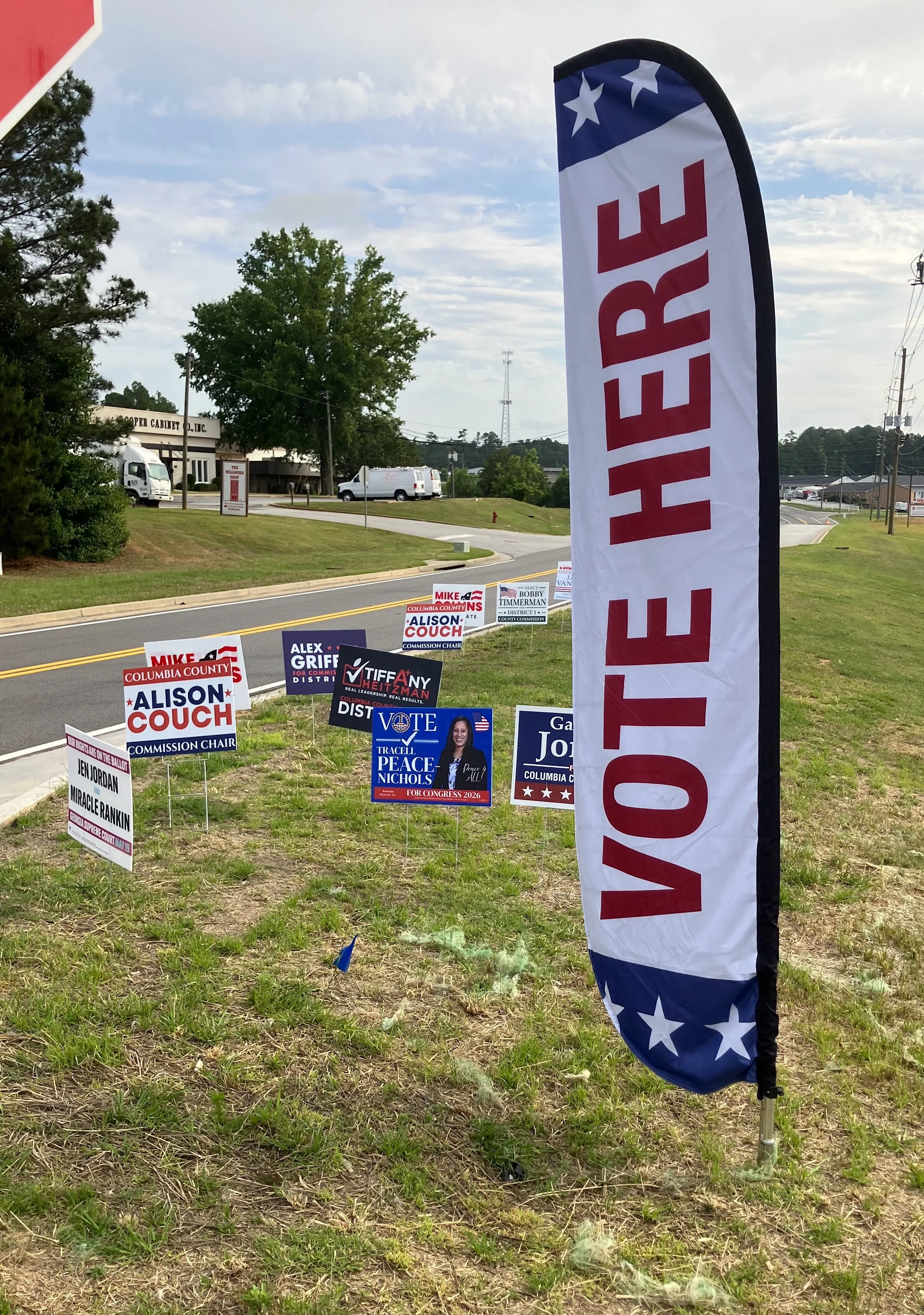
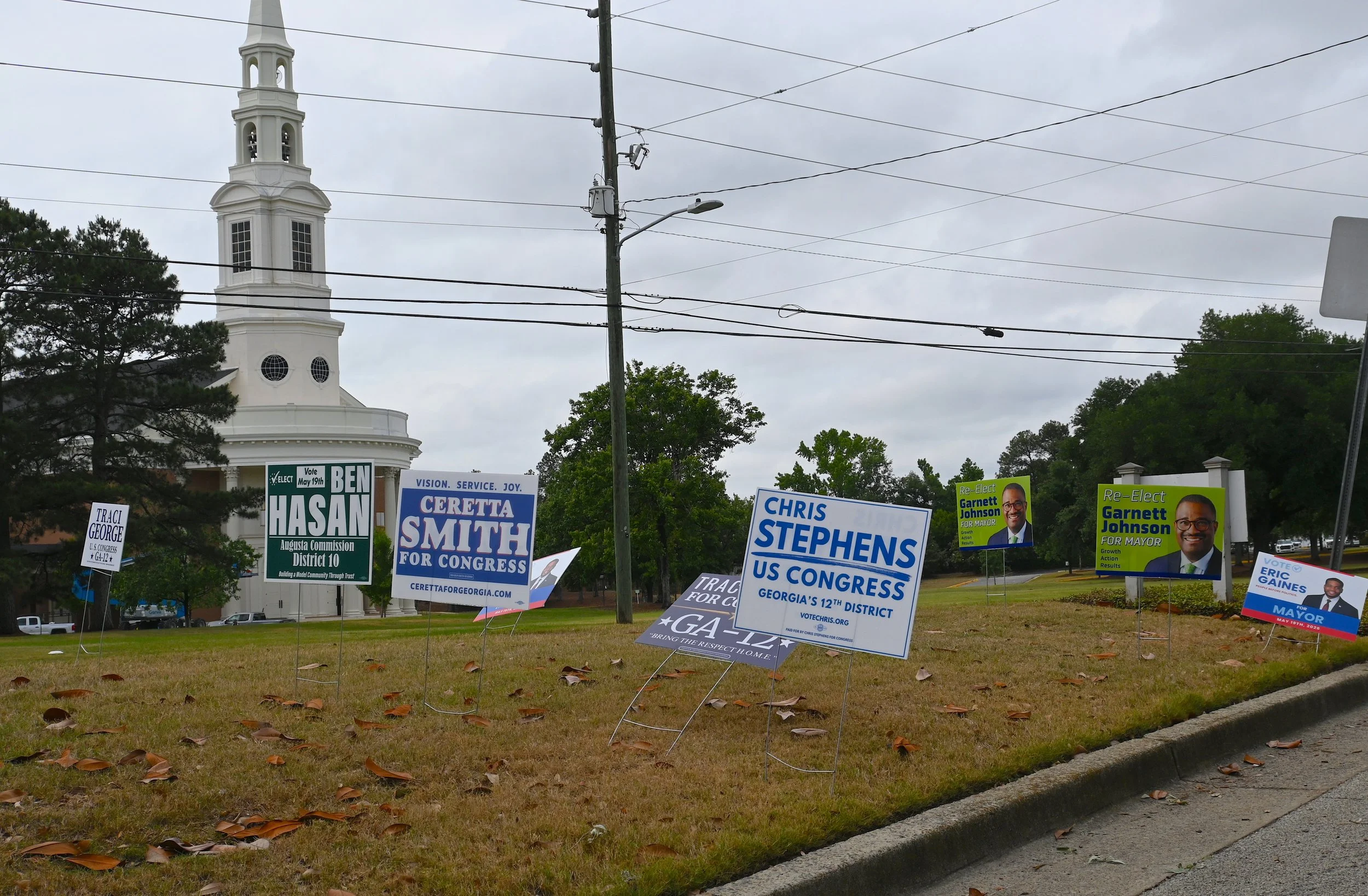
Voting sign in front of JA Discovery Center of the CSRA on the corner of Riverwatch Parkway and Columbia Industrial Boulevard in Evans. (staff photo) At the top of the page, politicians’ signs at Walton Way Extension in Augusta. (photo by Steve Schwartz/the Bell Ringer)